
Saudi Carbon Monitoring coordinates Method 21 and optical gas imaging in Saudi Arabia, helping industrial facilities select and run the leak-survey approach their programme requires. The two methods are widely discussed in leak programmes, but they do not produce the same type of evidence. Method 21 uses a portable instrument to determine VOC concentration at a potential leak interface under a defined procedure, while OGI visualises gases that a suitable camera can detect under the actual scene and operating conditions.
You receive a written proposal setting out the survey scope, delivery roles, deliverables, lead time and price. Request a quotation
Saudi Carbon Monitoring scopes, coordinates and manages the work; field surveys are delivered by trained, licensed or qualified parties named in each proposal, together with approved instruments, performance checks, hazardous-area arrangements and the rule used to classify and follow up observations. The applicable Saudi permit, authority requirement or corporate standard controls, and the two methods are not interchangeable or suitable for every gas.
What Method 21 contributes
US EPA Method 21 specifies an instrument-based procedure for determining VOC leaks. The instrument must meet stated performance requirements, and the work includes calibration and response checks, correct probe placement, background consideration and careful recording. A programme may define a leak at a particular concentration, but the threshold comes from the governing rule or programme, not from Method 21 alone.
Method 21 can generate component-level screening values in concentration units. It does not, by itself, provide a mass-emission rate. Quantification needs an approved correlation or other method, and the responsible practitioner accounts for the component population, service and operating period.
What OGI contributes
An optical gas imaging camera can help a trained operator scan many components and visualise emissions that are detectable within the camera’s spectral response and the scene conditions. Detection depends on the gas, concentration or rate, distance, temperature contrast, wind, background, equipment setup and operator technique. The current US EPA Appendix K documents US applicability and operating-condition boundaries for specified programmes; it is not universal Saudi law or a direct mass-rate method. A non-visible plume does not prove zero emissions.
OGI can be valuable for rapid screening, locating hard-to-find releases and communicating the leak position to maintenance. Whether it satisfies a required inspection, supports quantification or needs confirmation by another method is decided against the governing programme.
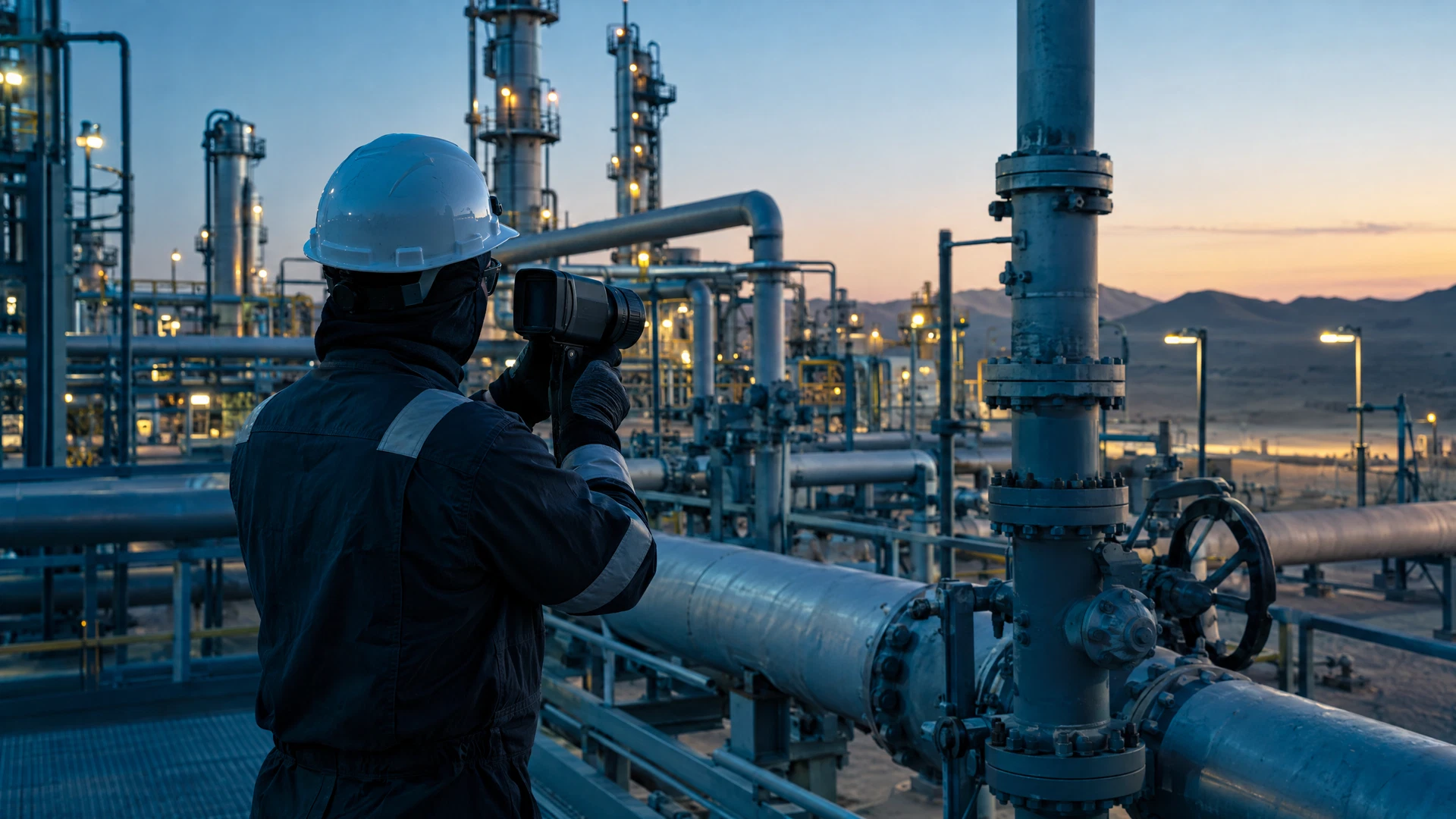
Method 21 and optical gas imaging in a combined workflow
A combined programme might use OGI to scan equipment and Method 21 for specified component measurements, or use one method as the primary survey and another for confirmation. The workflow needs rules for component identity, survey coverage, environmental limits, instrument checks, image and reading storage, leak classification, repair request and recheck.
All data connects to LDAR programme support rather than remaining as isolated videos or spreadsheets. Where mass estimates are needed, use a documented route under Fugitive Emissions Measurement and the inventory practitioner’s approval.
Field and data controls
Before mobilisation, confirm target compounds, expected conditions, component counts, hazardous-area classification, access, permits to work, instrument certifications, calibration gases, weather limits, tagging rules and maintenance interfaces. The field team records excluded or inaccessible areas, equipment not operating and any deviation from the planned route.
- OGI files: retain the original media, component ID, date and time, operator, equipment settings, distance and environmental context.
- Method 21: retain instrument identity, calibration and response checks, background, reading, component position and recheck result.
QA/QC and traceability governs corrections and version history. The service is available for projects across Saudi Arabia, including Dammam, Jubail and Riyadh.
What to request in a technical proposal
Ask the bidder to state the governing requirement, primary and secondary methods, target gases, instrument models, performance checks, operator competence, hazardous-area status, environmental limits and coverage assumptions. The proposal should explain whether OGI media are qualitative, whether Method 21 readings trigger the leak definition and whether any mass quantification is included. Avoid accepting the phrase “advanced camera survey” without a method and deliverable.
Require a component-level data schema and sample coverage report. It should show how readings or images link to equipment, how excluded areas are recorded and how repairs return for recheck. Confirm ownership and retention of original media and raw instrument files. If the scope is intended to support a permit, inventory or public claim, name that intended use and the independent reviewer. Procurement can then compare evidence and responsibilities rather than comparing only camera brands or daily survey rates.
Frequently asked questions
Who provides Method 21 and optical gas imaging in Saudi Arabia?
Saudi Carbon Monitoring provides Method 21 and optical gas imaging coordination in Saudi Arabia, scoping the survey and managing the data record.
Does Method 21 quantify kilograms per hour?
No. It provides a screening concentration under the method. A separate accepted approach is needed for mass-rate estimation.
Can OGI detect every hydrocarbon gas?
No. Detectability depends on the gas’s infrared properties, the camera, release conditions, background and operator technique.
How do I choose between Method 21 and OGI for my facility?
Follow the governing requirement. Both methods can be used in one programme when it allows, and the workflow explains how each contributes to detection, classification and recheck. OGI is not always faster; suitability matters more than survey pace.
What happens after a leak is found?
Create a controlled repair action, assign ownership and deadline, then perform the required recheck. See the repair-tracking service page.
What affects the cost of a Method 21 or OGI survey?
Cost depends on the component count, target gases, method or combination of methods, hazardous-area and access requirements, and the data and reporting deliverables.
How long does a leak survey take?
Timing depends on component count, access, conditions, documentation and follow-up. Lead time is confirmed in each quotation.
Saudi Carbon Monitoring serves projects across Saudi Arabia, including Dammam, Al Khobar, Jubail, Riyadh, Jeddah, NEOM and Qiddiya.
Request Method 21 and optical gas imaging in Saudi Arabia
Tell us your target gases, component count and governing programme, and we will scope Method 21 and optical gas imaging in Saudi Arabia to match. Request a quotation